Showing posts with label South America Snow Sessions. Show all posts

Sunday, November 20, 2011

SGT's carbon offset program - solar kitchens


Skiers and riders from around the world have come to rely on South America Snow Sessions for satisfying their summer backcountry fix. As the powder-hungry probably know by now, emissions from engines of all sorts, including planes, are stacking up as the number one threat to cold and consistent winters around the world. Now, with a carbon offset program in partnership with Wulcon Energy and the Ecoandina Foundation, the climate-conscious can choose to make sure their travel to and from Argentina isn't just pumping more CO2 into the atmosphere.
"We took an inventory and saw that about 85 percent of the carbon footprint of our trip to Argentina was caused by the flights," says SGT (SASS Global Travel) Sustainability Consultant Ryan Dunfee. "So retrofitting windows or some other project at our Bariloche compound really didn't seem to have as much of a net impact as focusing on the flight emissions."
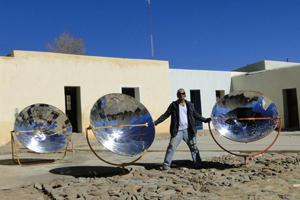
Courtesy of SASS
This is a solar kitchen.
Companies hoping to offset the impact of their operations typically partner with a carbon offset provider. The money from purchasing carbon offsets is invested into projects that should prevent more carbon from being released into the atmosphere, such as renewable energy like solar and wind. It sounds like a one-to-one erasure of a companies' impact, but problems arise when an offset provider deals in projects that have already been fully funded, or don't ever come to fruition
In SGT's case, Dunfee wanted to tackle the large impact of client and coach plane travel, and make sure their offsets were put to work locally. Dunfee connected with Martin Wainstein of Wulcon Energy, one of Argentina's first sustainability consultancies. Funded by SGT coaches and clients, Wainstein completed their first carbon offset project this past summer, installing two solar kitchens and a energy efficient stoves for rural high-desert villages.
"When he offered the idea of funding a self-contained local offset project, not just contribute cash to some huge wind farm, it was really attractive," says Dunfee. "Plus these solar kitchens and the heat-efficient stoves help these communities on a social level, even more than the reduction in CO2 emissions."
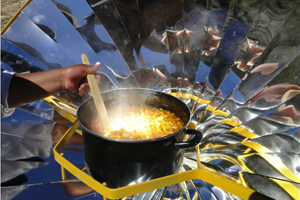
Courtesy of SASS
This is how a solar kitchen works.
Replacing conventional cooking stoves fueled by shrub wood, and providing high-efficiency heating stoves that reduce the amount of firewood needed, the project will offset "150 tons of CO2 over the next 20 years." That's equivalent to 30 round trip flights from Boston to Argentina, according to Dunfee. As he mentions, the project offers a great side-benefit: freeing up the villagers from the time-consuming labor of gathering fuel wood.
"You have young kids who are in school, and villagers who are trying to scrap out a living in a very rugged landscape, and all of a sudden they now have a few more hours in their day to do something productive instead of looking for firewood," says Dunfee.
No doubt getting to South America to score some August backcountry lines is a good investment. But, as Weinstein notes, an even more important one is making sure that climate change doesn't win -- and a great place to start is taking on the impact of travel when skiers and riders head out to play.
"We spoil ourselves and get to travel the world and use up all these resources that it has to offer without giving anything back," says Randall Stacy, a Rome am rider and SGT guide intern who offset his flight to Argentina through the project. "I realized that donating solar ovens to these people would be a small change in our lives and an enormous change for them. Then again, that gets me thinking: if a small change for me did so much for them, what would happen if we all made big changes in our lives to help the world?"
Story by Jesse Huffman, ESPN

Friday, June 10, 2011

SASS Global Travel "Why I Love My Home Mountain" Contest

For a chance to win some sick gear go to SASS Global Travel's Facebook page and enter their "Why I Love My Home Mountain" Essay Contest!

Friday, October 15, 2010

POW SUPPORTS SASS’S COLLABORATIVE ENVIRONMENTAL EFFORTS IN ARGENTINA


South America Snow Sessions (SASS) completed its first season of environmental and community projects in the city of San Carlos de Bariloche, Argentina with support from a variety of organization including Protect Our Winters, 1 Step, and the One Life crew of professional snowboarders. Participants included Michelle Parker, Mark Abma, Chanelle Sladics, Kjersi Buaas, and Jamie Anderson as well as musicians Cindy Santini and Marc Beauregard, the Green Guide Networks’ Casey Cochran, the Argentine sustainability consultancy Wulcon Energy, and SASS’s own interns, staff, and clients.

The collaboration produced a greenhouse made of recycled plastic bottles for a local school in Bariloche, a biodiesel processor to convert waste vegetable oil into usable biodiesel, and a carbon offset program for SASS clients in the desert Puna region of Argentina through the EcoAndina foundation. South America Snow Sessions hopes that this first season of projects will be the foundation for more substantial and diverse projects in the seasons to come. With the help of POW and 1 Step, SASS hopes to educate Argentina’s mountain communities about more sustainable practices while developing projects that serve those same communities.

“When I proposed the idea in January of doing these projects, I had no idea how many people we would connect with who were really energized to do this kind of work,” said Ryan Dunfee, SASS’s Sustainability Manager. “With everyone from environmental organizations to professional skiers and snowboarders to individuals to the Argentines that we ended up connecting with, we had a huge network of people eager to start tackling these environmental and community issues in South America, and these projects would not have been completed in the short time window we had without them.” With funding help from 1 Step and POW, people ran around town collecting thousands of used plastic bottles for the greenhouse walls, helped build a frame and a compost bin, and helped put together a biodiesel reactor made entirely from parts found around Bariloche. The crew was able to hand over both the greenhouse and the biodiesel reactor to the community by the time they left in mid-September.

The greenhouses were given to Secondary School No. 321 for use in a mentoring program where high school students teach primary school students how to grow and care for budding trees. The saplings are then used to reforest an area near the Cerro Catedral ski resort that burned down several years ago.

The biodiesel reactor was also transferred to a group of local Argentines working on their own biodiesel project. These Argentines will train Bariloche’s only recycling organization, the self funded Asociación de Recicladores de Bariloche, on how to use the reactor so that they can both recycle another waste product while lowering their fuel costs and environmental impact. Finally, SASS was able to develop its own carbon offset program for clients through the EcoAndina foundation of Argentina, which consisted of developing small-scale solar projects in the remote northern desert region of the country known as la Puna.

“We’re thrilled at the amount of work that was done in Bariloche this winter - the collaboration amongst everyone involved was amazing and it all really addressed the needs of the community and the environment,” said Chris Steinkamp, POW’s Executive Director.

“This was the first year for everyone involved doing work in Argentina, so more than anything it was an experiment to see what the needs, enthusiasm, and challenges would be like for environmental projects in Bariloche,” said Dunfee. “The results were extremely encouraging and now that we know what we’re doing, I’m excited to expand the scope and scale of the projects, both in Argentina and at SASS Global Travel’s other locations. We’ll be working with organizations like Waves for Development, a surf ‘voluntourism’ organization, to identify similar opportunities in tropical communities, as well as work with our existing partners to expand our environmental efforts in the snow community.”

Video of the greenhouse project - http://vimeo.com/15675359